How do I choose the correct gear pitch for my external gear application?
Introduction
In the world of mechanical engineering, choosing the correct gear pitch for an external gear application is crucial for the overall efficiency and functionality of the system. In this blog post, we will explore the various factors to consider when determining the appropriate gear pitch, as well as provide a comprehensive guide to making the best decision for your specific application.
Understanding Gear Pitch
Before delving into the selection process, it is essential to have a clear understanding of what gear pitch entails. Gear pitch refers to the distance between adjacent gear teeth and is typically measured in diametral pitch (DP) or module. The selection of the gear pitch depends on several factors, including the required load, speed, and precision of the application.
Factors to Consider when Choosing Gear Pitch
1. Load Requirements
In any external gear application, it is crucial to assess the load requirements accurately. The gear pitch should be selected based on the anticipated forces and torque that the gears will experience during operation. Factors such as weight, external forces, and any potential impacts should be taken into account to ensure the gears can withstand the expected loads.
2. Speed Considerations
The rotational speed at which the gears will operate plays a significant role in determining the appropriate gear pitch. Higher speeds may necessitate a finer gear pitch to ensure smooth operation and minimize noise and vibration. Conversely, lower speeds may allow for coarser gear pitches, depending on the application’s specific requirements.
3. Accuracy and Precision
For applications where accuracy and precision are of utmost importance, the gear pitch selection becomes critical. Fine gear pitches allow for greater precision, resulting in smoother gear engagement and reduced backlash. However, it is vital to balance the gear pitch with other factors, such as the intended lifespan of the gears and the ease of manufacturing.
Choosing the Right Gear Pitch
1. Evaluate Material Strength
Consider the material strength of the gears when selecting the gear pitch. Different materials have varying fatigue strengths, and the gear pitch should be chosen to ensure the gears can withstand the anticipated loads without failure.
2. Consider Tooth Engagement
The gear pitch should be selected to ensure proper tooth engagement. It is crucial to avoid extremes, such as overloading the teeth or having insufficient contact. Adequate tooth engagement promotes efficient power transmission and minimizes the risk of premature wear or tooth failure.
3. Seek Expert Advice
If you are unsure about the appropriate gear pitch for your application, it is highly recommended to consult with an experienced mechanical engineer or gear specialist. Their expertise can provide valuable guidance and ensure that the gear pitch aligns with your specific requirements.
Conclusion
Choosing the correct gear pitch for an external gear application is a critical decision that affects the overall performance and longevity of the system. By considering factors such as load requirements, speed considerations, accuracy, and material strength, you can make an informed choice that maximizes efficiency and reliability. Remember, when in doubt, always seek professional advice to ensure the optimal gear pitch is selected for your application.
Our company specializes in the production and sale of external gears, providing high-quality solutions for various applications. With our expertise in the field of external gears, we have several key advantages:
Advantages of Choosing our External Gears:
1. Superior Durability:
Our external gears are manufactured using top-grade materials, ensuring exceptional durability and longevity.
2. Precise Engineering:
We employ advanced manufacturing techniques and rigorous quality control measures to ensure the precise engineering of our external gears, resulting in optimal performance.
3. Wide Range of Sizes:
Our company offers a diverse range of external gears in various sizes, providing flexibility to meet the unique requirements of different applications.
4. Customization Options:
We understand that every application has specific needs. Therefore, we offer customization options for our external gears, allowing you to tailor them according to your precise requirements.
5. Competitive Pricing:
Despite offering superior quality and performance, our external gears are competitively priced, providing excellent value for your investment.

Different Types of External Gears:
1. Spur Gears:
Spur gears are the most common type of external gears and are widely used for transmitting motion between parallel shafts.
2. Helical Gears:
Helical gears have angled teeth, which allows for smoother and quieter operation compared to spur gears. They are ideal for applications that require high precision and reduced noise.
3. Bevel Gears:
Bevel gears are used for transmitting motion between intersecting shafts. They have conical-shaped teeth and are suitable for applications that require changes in direction.
4. Worm Gears:
Worm gears consist of a worm (a screw-like gear) and a worm wheel. They provide high gear ratios and are commonly used in applications requiring large speed reductions.
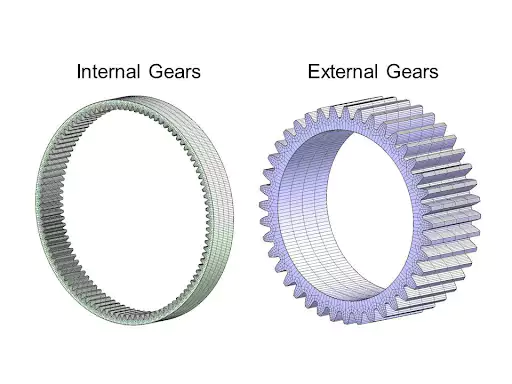
Comparison between External and Internal Gears:
| Aspect | External Gears | Internal Gears |
|---|---|---|
| Positioning | Located outside the gear cylinder | Located inside the gear cylinder |
| Efficiency | High efficiency due to minimal friction | Lower efficiency due to increased friction |
| Complexity | Relatively simpler design | More complex design |
| Load Distribution | Even distribution of load across teeth | Concentrated load distribution on teeth |
Roles of External Gears in Power Transmission:
1. Torque Transmission:
External gears efficiently transmit torque from one shaft to another, enabling the transfer of power between different components of a system.
2. Speed Regulation:
By adjusting the gear ratio, external gears allow for precise speed regulation in various applications, ensuring optimal performance and efficiency.
3. Load Distribution:
External gears evenly distribute the load across the teeth, minimizing wear and ensuring uniform power transmission.
4. Directional Changes:
External gears facilitate changes in the direction of motion by meshing with other gears at different angles, allowing for versatile power transmission.
Typical Applications of External Gears:
1. Automotive Sector:
External gears are widely used in automotive transmissions, ensuring smooth and efficient power transfer between different components of the drivetrain.
2. Industrial Machinery:
Various industrial machinery, such as conveyors and machine tools, utilize external gears to transmit power and control rotational speed.
3. Appliances & Precision Instruments:
External gears play a critical role in appliances like washing machines and precision instruments, ensuring accurate and reliable performance.
4. Electric Vehicles & Hybrid Systems:
External gears are essential in electric vehicles and hybrid systems, enabling efficient power transmission between the electric motor and wheels.
Design and Selection Considerations for External Gears:
When designing and selecting external gears, factors such as load requirements, speed, tooth profile, material selection, and lubrication need to be carefully considered. Our team of experts can assist you in making the right choices for your specific application.
Partner with us for your external gear needs, and experience the reliability, performance, and value that our products offer.
Author: Miya