Gear Finishing Techniques for External Gears
Introduction
Gear finishing techniques are crucial for achieving high precision and quality in the manufacturing of external gears. In this article, we will explore various methods used to enhance the surface finish and overall performance of external gears.
1. Grinding
Grinding is a widely employed gear finishing technique that involves the use of abrasive wheels to remove material and improve the dimensional accuracy of external gears. It is particularly effective in achieving tight tolerances and reducing gear noise.
2. Honing
Honing is a precision machining process used to improve the surface texture and geometry of external gears. By using a rotating abrasive stone, honing creates a cross-hatch pattern that enhances lubrication and reduces friction, resulting in improved gear performance.
3. Lapping
Lapping is a specialized gear finishing technique that involves the use of a lapping tool and abrasive slurry to achieve high dimensional accuracy and surface finish. It is commonly used for gears that require extremely tight tolerances and exceptional smoothness.
4. Burnishing
Burnishing is a cold working process that uses a hardened roller or ball to smooth and harden the surface of external gears. This technique improves the gear’s load-carrying capacity, reduces wear, and enhances the overall durability of the gear.
5. Superfinishing
Superfinishing is an advanced gear finishing technique that utilizes abrasive stones or tapes to achieve ultra-smooth surface finishes on external gears. This process reduces friction, improves gear efficiency, and extends the gear’s lifespan.
6. Shot Peening
Shot peening is a surface treatment technique that bombards the external gear’s surface with small spherical media to induce compressive stresses. This process enhances the gear’s resistance to fatigue, improves its strength, and prolongs its service life.
7. Electroplating
Electroplating is a gear finishing technique that involves depositing a layer of metallic coating on the gear’s surface through an electrochemical process. This technique provides corrosion resistance, improves hardness, and enhances the aesthetics of the external gears.
8. Gear Hobbing
Gear hobbing is a gear cutting process that can also be used as a gear finishing technique for external gears. By using a hobbing machine, precise gear profiles can be achieved, ensuring proper gear meshing and optimal performance.
9. Vibratory Finishing
Vibratory finishing is a mass finishing technique that uses a vibrating container filled with abrasive media to remove burrs, improve surface finish, and enhance the overall appearance of external gears. It is suitable for high-volume gear production.
10. Cryogenic Treatment
Cryogenic treatment is a gear finishing technique that involves subjecting the external gears to extremely low temperatures. This process refines the gear’s microstructure, increases wear resistance, and improves the gear’s overall performance under heavy loads.
11. Ion Nitriding
Ion nitriding is a surface hardening technique that introduces nitrogen into the external gear’s surface to improve its wear resistance and hardness. This process forms a hard nitride layer, increasing the gear’s durability and extending its lifespan.
12. Laser Beam Machining
Laser beam machining is a precision gear finishing technique that uses a focused laser beam to remove material from the external gear’s surface. This non-contact process can achieve intricate profiles and precise surface finishes, making it suitable for complex gear designs.
13. Magnetic Particle Inspection
Magnetic particle inspection is a non-destructive testing method used to detect surface cracks and defects in external gears. By applying magnetic particles to the gear’s surface and using magnetic fields, flaws can be easily identified, ensuring the gear’s quality and reliability.
14. Ultrasonic Testing
Ultrasonic testing is another non-destructive gear inspection technique that utilizes high-frequency sound waves to detect internal and surface defects in external gears. This method is highly accurate, providing valuable information on the gear’s structural integrity and quality.
15. Gear Measurement and Analysis
Accurate gear measurement and analysis play a crucial role in gear finishing. By using advanced metrology equipment and software, gear manufacturers can ensure the dimensional accuracy, tooth profile, and overall quality of the external gears.
Conclusion
Gear finishing techniques for external gears are essential for achieving optimal performance, durability, and precision. By employing various methods such as grinding, honing, lapping, and more, manufacturers can enhance the surface finish, dimensional accuracy, and overall quality of external gears, meeting the demanding requirements of modern industries.
Our company specializes in the production and sale of external gears, offering a wide range of gear finishing techniques for external gears. As an expert in SEO copywriting, I will now introduce the advantages of our company and provide detailed explanations for each point.
Advantages of Our Company:
- Superior Quality: We pride ourselves on delivering external gears of the highest quality, meeting or exceeding industry standards. Our gears are designed to provide exceptional performance and durability.
- Advanced Technology: Our company utilizes cutting-edge gear finishing techniques, ensuring precise and efficient manufacturing processes. We continuously invest in research and development to stay at the forefront of technological advancements.
- Customization Options: We understand that different applications require specific gear specifications. Our company offers a wide range of customization options to meet the unique needs of our customers. From materials to dimensions, we can tailor our external gears accordingly.
- Competitive Pricing: While maintaining superior quality, we also strive to offer competitive pricing in the market. Our efficient production processes and economies of scale allow us to provide cost-effective solutions without compromising on quality.
- Excellent Customer Service: Our dedicated team of professionals is committed to providing exceptional customer service. We prioritize prompt responses, clear communication, and reliable support throughout the entire process, ensuring the satisfaction of our clients.
Now, let’s explore the different types of external gears:
Types of External Gears:

1. Spur Gears: Spur gears have straight teeth, and they are the most common type of external gears. They provide efficient power transmission and are suitable for various applications.
2. Helical Gears: Helical gears have angled teeth, resulting in smoother and quieter operation compared to spur gears. They can handle higher loads and are commonly used in heavy machinery and automotive applications.
3. Bevel Gears: Bevel gears have cone-shaped teeth and are used to transmit power between intersecting shafts. They are commonly found in applications where changes in direction or torque are required.
4. Worm Gears: Worm gears consist of a screw-like gear (worm) and a toothed wheel (worm gear). They offer high gear ratios and are used when high reduction is needed, such as in conveyor systems or lifts.
5. Rack and Pinion Gears: Rack and pinion gears convert rotational motion into linear motion. They are commonly used in steering systems, elevators, and other applications where precise linear movement is required.
Next, let’s compare the differences between external and internal gears:
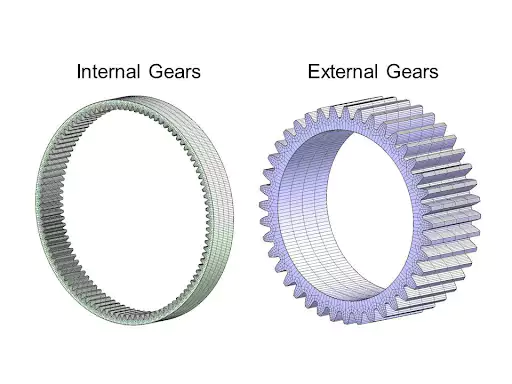
| Comparison | External Gear | Internal Gear |
|---|---|---|
| Teeth Orientation | Situated on the outer surface of the gear | Situated on the inner surface of the gear |
| Engagement | Engages with gears outside of the gear | Engages with gears inside of the gear |
| Applications | Commonly used in various industries | Used in specific applications where space is limited |
| Noise | External gears generally produce more noise | Internal gears are quieter due to the meshing configuration |
| Complexity | External gears are relatively simpler in design | Internal gears require more complex design considerations |
Now, let’s explore the role of external gears in transmission systems:
Role of External Gears in Transmission Systems:
- Power Transmission: External gears efficiently transmit power from one component to another, ensuring smooth operation and torque transfer.
- Gear Ratio: By using different gear sizes, external gears allow for gear ratio adjustments, enabling speed and torque control in transmission systems.
- Noise Reduction: Properly designed external gears can minimize noise and vibrations, ensuring quieter operation in transmission systems.
- Load Distribution: External gears distribute loads evenly across teeth, preventing premature wear and failure of the gear system.
- Efficiency: With their precise tooth engagement, external gears offer high transmission efficiency, minimizing power losses in the system.
External gears find applications in various industries, including:
Applications of External Gears:
- Automotive: External gears are widely used in automotive transmissions, ensuring efficient power transfer and smooth gear shifting.
- Industrial Machinery: External gears play a crucial role in industrial machinery, such as conveyor systems, machine tools, and printing presses.
- Home Appliances and Precision Instruments: External gears can be found in appliances like washing machines, blenders, and also in precision instruments such as watches and cameras.
- Electric and Hybrid Power Systems: External gears are essential components in electric vehicles and hybrid power systems, facilitating the conversion and distribution of power.
When it comes to the design and selection of external gears, factors such as torque requirements, operating conditions, and material considerations must be taken into account. Our experienced team can provide expert guidance and support in designing and selecting the most suitable external gears for your specific needs.
We are committed to delivering high-quality external gears, customized solutions, and excellent customer service. Partner with us today for all your external gear requirements!
Author: Miya