How to Calculate the Required Input Torque for a Screw Jack?
Determining the required input torque for a screw jack is a critical aspect of many industrial and mechanical applications. This process involves understanding the principles of mechanics, torque, and the specific characteristics of screw jacks. This guide will explain these concepts in detail and provide a step-by-step guide on how to calculate the required input torque for a screw jack.
Understanding Screw Jacks
A screw jack is a mechanical device used to lift heavy loads or to apply great forces. It operates based on the principle of linear motion, converting rotational motion into linear motion. Depending on the application, the screw jack can either lift, lower, slide, or adjust objects in a controlled, predictable manner.
Basic Principles of Torque
Before diving into the calculations, it’s important to understand the basic principles of torque. Torque, also known as moment or moment of force, is the rotational equivalent of linear force. It is calculated by multiplying the force applied by the distance from the pivot point at which the force is applied. The resulting torque is expressed in Newton-meters (Nm) or foot-pounds (ft-lbs) in the Imperial system.
Components of a Screw Jack
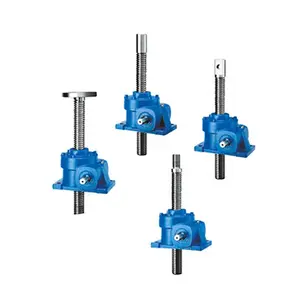
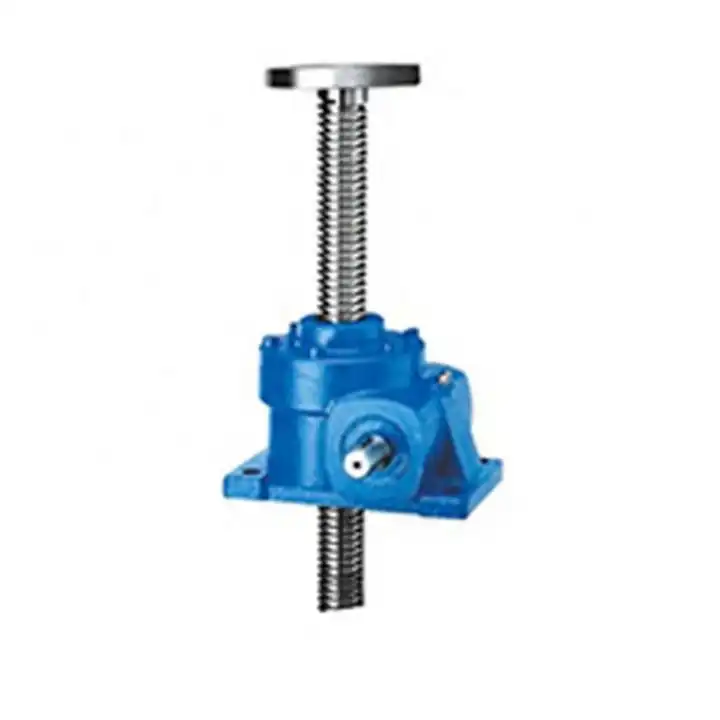
A screw jack consists of several components, including the input shaft, screw or worm gear, and the load-bearing platform or cap. The input shaft is connected to the drive motor, which provides the rotational motion. The worm gear or screw converts this rotational motion into linear motion, moving the load-bearing platform up or down.
Calculating the Required Input Torque
Now, let’s look at how to calculate the required input torque for a screw jack. There are several factors that need to be considered in this calculation, including the load weight, the efficiency of the screw jack, the lead of the screw, and the gravitational constant.
The basic formula for calculating the required input torque (T) is:
T = (F x L) / (η x 2π)
Where:
- F is the load force (in Newtons)
- L is the lead of the screw (in meters)
- η is the efficiency of the screw jack (a value between 0 and 1)
- π is the constant pi (~3.14159)
This formula assumes that the load is being lifted vertically, so the force F is simply the weight of the load. If the load is being moved along an incline, the calculation becomes more complex and you need to factor in the angle of the incline.
Example Calculation
Suppose we have a screw jack with a lead of 0.01 meters, an efficiency of 0.3, and we want to lift a load of 1000 kg. The force F is the weight of the load, which is its mass multiplied by the gravitational constant (9.81 m/s^2).
F = m x g = 1000 kg x 9.81 m/s^2 = 9810 N
Then, we can substitute these values into the formula to find the required input torque.
T = (F x L) / (η x 2π)

  = (9810 N x 0.01 m) / (0.3 x 2π)

  = 5205 Nm
So, the required input torque for this screw jack is 5205 Nm.
Conclusion
Calculating the required input torque for a screw jack is a critical step in many industrial and mechanical applications. By understanding the principles of mechanics and torque, and the specific characteristics of your screw jack, you can accurately calculate the required input torque and ensure your system operates safely and efficiently.