How do spiral bevel gears manage torsional vibration in high-power transmission scenarios?
Introduction
Torsional vibration is a critical concern in high-power transmission scenarios, as it can lead to excessive wear, noise, and even system failure. Spiral bevel gears, with their unique design and characteristics, play a crucial role in managing and mitigating torsional vibration. In this article, we will explore the various ways spiral bevel gears effectively handle torsional vibration in high-power transmission scenarios.
Understanding Spiral Bevel Gears
Spiral bevel gears are a type of bevel gear that has helical teeth. These gears are designed to transmit torque between intersecting shafts at varying angles. The spiral bevel gear’s distinct features, such as its curved teeth and spiral pattern, enable it to effectively handle torsional vibration in high-power transmission scenarios.
1. Curved Teeth and Contact Pattern Optimization
Spiral bevel gears are designed with curved teeth that allow for gradual tooth engagement. This gradual contact pattern helps in reducing impact and shock loads during transmission, thus minimizing torsional vibration. The optimization of the contact pattern ensures uniform load distribution and enhanced gear performance.
2. Precision Manufacturing and Tooth Surface Finishing
The precision manufacturing process of spiral bevel gears ensures high dimensional accuracy and tight tolerances. This precision, combined with advanced tooth surface finishing techniques such as grinding and honing, results in smooth and precise tooth profiles. The improved tooth surface quality reduces friction and vibration, enhancing the overall performance of the gears in high-power transmission scenarios.
3. Gear Geometries and Tooth Modifications
Spiral bevel gears utilize specific gear geometries and tooth modifications to manage torsional vibration. Features such as crowning, lead crowning, and tip relief are incorporated to optimize gear meshing and provide better load distribution. These modifications help in reducing noise, vibration, and the potential for tooth breakage, making spiral bevel gears suitable for high-power transmission applications.
4. Material Selection and Heat Treatment
The choice of materials for spiral bevel gears is crucial in managing torsional vibration. High-quality alloy steels with excellent mechanical properties are commonly used to ensure strength and durability. Heat treatment processes like carburizing, nitriding, or quenching and tempering further enhance the gear’s surface hardness, wear resistance, and fatigue strength, minimizing torsional vibration effects.
5. Lubrication and Cooling
Proper lubrication and cooling are essential factors in reducing torsional vibration. Spiral bevel gears require adequate lubrication to minimize friction and wear between gear surfaces, thus reducing vibration levels. Additionally, efficient cooling mechanisms, such as oil circulation systems or cooling fins, help dissipate heat generated during high-power transmission, preventing excessive vibration due to thermal effects.
6. Dynamic Balancing and System Integration
Dynamic balancing of spiral bevel gears ensures even distribution of mass and minimizes unbalanced forces, which can contribute to torsional vibration. System integration, including precise alignment and proper installation of the gears, further enhances their ability to manage torsional vibration in high-power transmission scenarios.
7. Vibration Analysis and Testing
Advanced vibration analysis techniques and testing methods are employed to assess and optimize the performance of spiral bevel gears. These analyses help identify potential vibration sources, detect irregularities, and ensure the gears operate within acceptable vibration limits in high-power transmission applications.
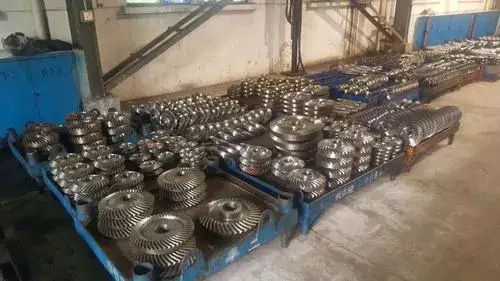
After completing the article, it is important to introduce our gear manufacturing factory and explain our processing techniques and processes:
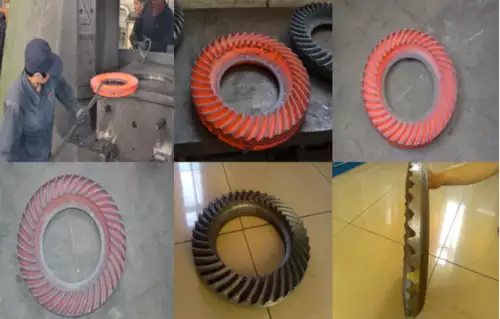
At our gear manufacturing factory, we utilize a comprehensive processing workflow to ensure the highest quality gears. The process includes the following steps:
- Raw Material Preparation: Forging and Heat Treatment
- Rough Machining: Turning, Drilling, and Boring
- Forming Process: Gear Rolling, Gear Hobbing, and Gear Shaving
- Semi-Finishing: Chamfering, Keyway Cutting, and Deburring
- Heat Treatment: Carburizing, Nitriding or Quenching and Tempering
- Finishing: Gear Grinding and Honing
- Inspection and Acceptance: Gear Testing and Surface Treatment
The first step involves preparing the raw material by forging it into the desired shape. After forging, heat treatment processes, such as hardening and tempering, are performed to enhance the material’s mechanical properties.
In the rough machining stage, the forged blanks are machined using turning, drilling, and boring operations. These processes shape the gears to their approximate dimensions and create the necessary holes and bores.
Next, the gears go through the forming process, which includes gear rolling, gear hobbing, and gear shaving. These operations accurately shape the teeth profiles, ensuring precise gear meshing and optimal performance.
After the forming process, the gears undergo semi-finishing operations such as chamfering, keyway cutting, and deburring. These steps ensure smooth edges, proper keyway slots, and remove any burrs or sharp edges.
In the heat treatment stage, the gears are subjected to processes like carburizing, nitriding, or quenching and tempering. These heat treatment methods enhance the gears’ surface hardness, wear resistance, and overall strength.
Finishing operations, such as gear grinding and honing, are performed to achieve the final gear dimensions and surface finish. These processes ensure precise tooth profiles, reduce friction, and improve noise characteristics.
The final step involves rigorous inspection and acceptance testing. Gear testing methods, including gear measurement and analysis, ensure the gears meet the specified requirements. Additionally, suitable surface treatments, such as corrosion protection or coating, can be applied to enhance the gears’ performance and longevity.
Our gear manufacturing factory takes pride in delivering high-quality gears with the following advantages:
- Advanced manufacturing techniques and precision machining processes
- Extensive experience in gear design and customization
- Strict quality control measures and thorough testing procedures
- State-of-the-art facilities and modern machinery
- Efficient production capacity and timely delivery
- Competitive pricing and customer-centric approach
- Flexible collaboration options, including OEM and customized solutions
Partner with us for your gear needs and experience the reliability and excellence that our gears offer.
Author: Miya