Spiral Bevel Gear in Tunnel Boring Machines
Introduction
The use of spiral bevel gears in tunnel boring machines has revolutionized the construction industry. These gears play a crucial role in the efficient and reliable operation of tunnel boring machines, enabling the excavation of tunnels with precision and accuracy. In this article, we will explore the various aspects of spiral bevel gears in tunnel boring machines, including their design, function, and manufacturing process.
1. Overview of Spiral Bevel Gears
Spiral bevel gears are a type of bevel gear that have spiral-shaped teeth. They are used in applications where the transmission of power between non-parallel axes is required. In tunnel boring machines, spiral bevel gears are responsible for transmitting power from the main drive motor to the cutterhead, allowing the machine to excavate the tunnel.
2. Design Considerations
The design of spiral bevel gears in tunnel boring machines involves several critical considerations. These include the gear ratio, tooth profile, and backlash. The gear ratio determines the speed and torque required for the cutterhead, while the tooth profile ensures smooth and efficient power transmission. Minimizing backlash is essential to maintain precision and minimize vibration during operation.
3. Manufacturing Process
The manufacturing process of spiral bevel gears in tunnel boring machines involves several steps:
3.1. Blank Preparation: Forging and Heat Treatment
Before the gears are machined, the blanks are prepared through forging and heat treatment. Forging ensures the desired material properties and shape, while heat treatment enhances the gears’ strength and durability.
3.2. Rough Machining: Turning, Drilling, and Boring
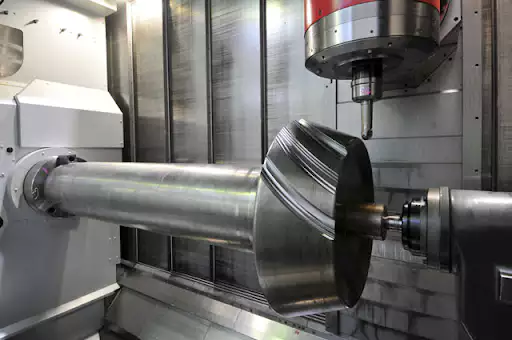
After the blanks are prepared, rough machining processes such as turning, drilling, and boring are carried out. Turning shapes the outer diameter of the gear, drilling creates holes for shafts and bearings, and boring ensures the precise alignment of the gear teeth.
3.3. Forming Process: Gear Rolling, Gear Hobbing, and Gear Shaving
The forming process involves shaping the gear teeth. Gear rolling, gear hobbing, and gear shaving are commonly used methods. Gear rolling creates the initial tooth profile, gear hobbing refines the profile, and gear shaving achieves the final tooth surface finish.
3.4. Semi-Precision Machining: Chamfering, Keyway Cutting, and Deburring
After the forming process, semi-precision machining operations are performed. Chamfering removes sharp edges, keyway cutting creates slots for key connections, and deburring eliminates any remaining burrs or imperfections.
3.5. Heat Treatment: Carburizing, Nitriding or Quenching, and Tempering
Heat treatment is essential to enhance the gears’ hardness and wear resistance. Carburizing enriches the surface carbon content, nitriding or quenching improves the surface hardness, and tempering reduces internal stresses and increases toughness.
3.6. Precision Machining: Gear Grinding and Honing
Precision machining processes such as gear grinding and honing are carried out to achieve the desired gear accuracy, surface finish, and noise reduction. Gear grinding removes any remaining imperfections and ensures precise gear dimensions, while honing improves the gear tooth surface finish.
3.7. Inspection and Acceptance: Gear Testing and Surface Treatment
Before the gears are ready for installation, they undergo thorough inspection and acceptance procedures. Gear testing ensures the gears meet the required specifications and standards, while surface treatment, such as coating or plating, is applied to enhance corrosion resistance and improve aesthetics.
4. Our Factory’s Advantages
As a professional gear manufacturing factory, we take pride in our expertise and capabilities. Our advantages include:
4.1. Advanced Technology and Equipment
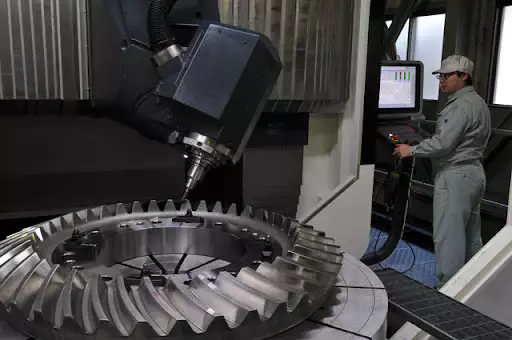
We employ advanced technology and state-of-the-art equipment in our gear manufacturing processes. This allows us to produce high-quality spiral bevel gears with precision and efficiency.
4.2. Skilled Workforce
Our team consists of highly skilled engineers and technicians who are knowledgeable in gear design, manufacturing, and quality control. They ensure that every gear we produce meets the highest standards of excellence.
4.3. Comprehensive Quality Control
Quality control is an integral part of our manufacturing process. We have established strict quality control measures at every stage, from material selection to final inspection. This ensures that our gears are reliable, durable, and perform optimally in tunnel boring machines.
4.4. Customization and Flexibility
We understand that different tunnel boring projects have unique requirements. Therefore, we offer customization options to meet specific gear specifications and design needs. Our flexible manufacturing capabilities enable us to adapt to various project requirements efficiently.
4.5. Timely Delivery and Excellent Customer Service
We are committed to delivering our products on time, ensuring that our customers’ project timelines are met. Additionally, we provide excellent customer service, addressing any inquiries or concerns promptly and professionally.
With our advanced manufacturing processes, skilled workforce, comprehensive quality control, customization options, and excellent customer service, we are the ideal partner for all your spiral bevel gear needs in tunnel boring machines.
Conclusion
In conclusion, the use of spiral bevel gears in tunnel boring machines is essential for efficient and accurate tunnel excavation. Understanding the design considerations and the manufacturing process of these gears is crucial to ensure their optimal performance. Our factory, with its advanced technology, skilled workforce, and commitment to excellence, is the ideal choice for high-quality spiral bevel gears. Contact us today to discuss your specific gear requirements and explore how we can assist you in your tunnel boring projects.
Author: Miya