Self-locking Mechanisms in Slewing Gearboxes
Introduction
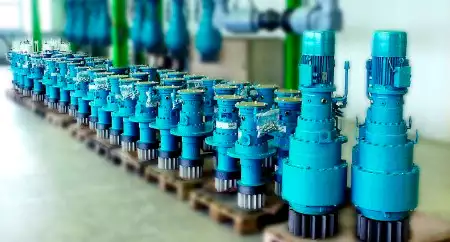
Slewing gearboxes play an important role in various industrial applications. They are used to rotate heavy equipment such as cranes, excavators, and wind turbines. In order to ensure the safety and stability of these applications, self-locking mechanisms are often integrated into the slewing gearboxes. But what exactly are self-locking mechanisms and how do they work? This article will explain the basics of self-locking mechanisms in slewing gearboxes.
What are Self-locking Mechanisms?
Self-locking mechanisms are designed to prevent a gearbox from rotating when there is no external force applied to it. In other words, they lock the gearbox in place and prevent it from turning on its own. This is important in slewing applications because it ensures that the equipment stays in place and does not accidentally rotate, which could cause damage to the equipment, the operator, or the environment.
Types of Self-locking Mechanisms
There are two main types of self-locking mechanisms used in slewing gearboxes: friction based and locking-pin based.
Friction Based Mechanisms
Friction based mechanisms rely on the friction between two surfaces to lock the gearbox in place. This can be achieved by adding a brake pad or a friction plate to the gearbox. When the brake pad or friction plate is engaged, it creates friction with the gearbox housing, which prevents the gearbox from rotating. Friction based mechanisms are simple and reliable, but they can wear out over time and may require maintenance.
Locking-pin Based Mechanisms
Locking-pin based mechanisms use a series of pins or bolts to lock the gearbox in place. These pins or bolts are inserted into holes on the gearbox housing and prevent the gearbox from rotating. Locking-pin based mechanisms are more durable than friction based mechanisms but they can be more complex and expensive to manufacture.
Benefits of Self-locking Mechanisms
The main benefit of self-locking mechanisms is safety. By preventing the gearbox from rotating on its own, self-locking mechanisms reduce the risk of accidents and equipment damage. Additionally, self-locking mechanisms can improve the precision and accuracy of slewing applications. By locking the gearbox in place, operators can position the equipment more precisely and avoid overshooting the target position.
Conclusion
Self-locking mechanisms are an essential component of slewing gearboxes. They help to ensure the safety and stability of various industrial applications. There are two main types of self-locking mechanisms: friction based and locking-pin based. Each type has its own advantages and disadvantages, and the choice of mechanism will depend on the specific application.

About Our Company
We are a leading company specializing in the research, design, and manufacture of planetary gearboxes. Our gearboxes are used in various industries including aerospace, defense, and robotics. We are committed to providing our customers with high-quality and reliable products that meet their specific needs.
Planetary Gearbox/Reducer Procurement Guide
| Factor | Consideration |
|---|---|
| Application | Consider the specific requirements of your application, such as torque, speed, and power. Choose a gearbox that is designed to meet those requirements. |
| Size | Choose a gearbox that is the right size for your application. Consider the available space and the weight of the gearbox. |
| Efficiency | Choose a gearbox with a high efficiency rating. This will help to minimize energy loss and reduce operating costs. |
| Cost | Consider the cost of the gearbox, as well as any maintenance or repair costs that may be required over the lifespan of the product. |
| Manufacturer | Choose a reputable manufacturer with a proven track record of delivering high-quality and reliable gearboxes. |
Author: Miya