Mounting options for Hollow Rotary Actuators
Introduction
Hollow rotary actuators are commonly used in industrial applications such as robotics, automation, and aerospace. They are preferred due to their high precision, torque, and speed. In this article, we will discuss the different mounting options for these actuators that are available to engineers and designers.
Flange Mounting
Flange mounting is the most common method for mounting hollow rotary actuators. This method involves attaching the actuator to a mounting plate or flange using bolts. Flange mounting is preferred due to its simplicity, ease of installation, and high rigidity.
Face Mounting
Face mounting involves mounting the actuator directly onto the machine face. This method is preferred when there is limited space available for mounting. Face mounting is also preferred in applications where high accuracy is required.
Base Mounting
Base mounting involves mounting the actuator onto a base or frame. This method is preferred when the actuator needs to be elevated or when the machine frame is an integral part of the actuator.
Through-Hole Mounting
Through-hole mounting involves mounting the actuator onto a shaft that passes through the center of the actuator. This method is preferred in applications where the actuator needs to rotate around a central axis.
Table Mounting
Table mounting involves mounting the actuator onto a rotary table. This method is preferred when the actuator needs to rotate horizontally and vertically.
Summary
Choosing the right mounting option for a hollow rotary actuator depends on several factors such as available space, accuracy requirements, and the need for elevation or rotation. Flange mounting is the most common method due to its simplicity and rigidity. Face mounting is preferred when high accuracy is required, while base mounting is suitable for applications that require elevation. Through-hole and table mounting are preferred when the actuator needs to rotate around a central axis or in both horizontal and vertical directions.
Hollow Rotary Actuator Design and Selection Considerations
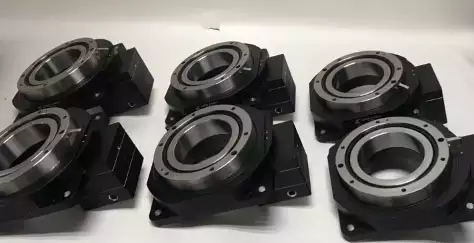
| Consideration | Description |
|---|---|
| Load Capacity | The load capacity of the actuator should be sufficient to handle the weight of the load and any external forces. |
| Speed | The actuator should be able to rotate at the required speed for the application. |
| Precision | The actuator should have the required precision for the application. |
| Torque | The actuator should have the required torque to handle the load and any external forces. |
| Environmental Conditions | The actuator should be able to operate in the required environmental conditions such as temperature and humidity. |
| Mounting Options | The actuator should have the appropriate mounting options for the application. |
At our company, we specialize in the research, development, design, manufacturing, sales, and service of servo electric cylinders, servo press equipment, and other modern servo stamping equipment. We have a professional design team, processing team, assembly team, sales team, and after-sales service team. Our company mainly develops and produces servo cylinders, servo press machines, electric push rods, electric slide tables, multi-degree-of-freedom platforms, and other servo stamping equipment. We are committed to providing high-quality and efficient products and services to our customers.
If you are looking for a reliable and professional supplier for your hollow rotary actuator needs, please do not hesitate to contact us. We will provide you with the best solution and value for your application.

Author: Miya