How do I analyze the fatigue life of a spline shaft under cyclic loading?
Introduction
A spline shaft is a crucial component in many mechanical systems, transmitting torque and rotational motion between different parts. However, it is subjected to cyclic loading, which can lead to fatigue and ultimately failure. In this blog post, we will explore the analysis of fatigue life in a spline shaft and discuss the key considerations and methodologies involved.
1. Material Selection for Spline Shaft
Choosing the right material is essential to ensure the spline shaft’s durability and fatigue resistance. Factors such as strength, ductility, and fatigue properties must be taken into account. High-strength steel alloys, such as AISI 4140 or 4340, are commonly used due to their excellent mechanical properties and fatigue resistance.
2. Fatigue Life Calculation Methods
There are several methods to analyze the fatigue life of a spline shaft under cyclic loading:
- Stress-Life Method: This method involves determining the stress amplitude and mean stress values and using them to estimate the fatigue life through S-N curves specific to the material.
- Strain-Life Method: Instead of stress, this method focuses on the strain response of the spline shaft. It accounts for the material’s cyclic behavior and provides an estimation of fatigue life based on strain-life curves.
- Finite Element Analysis (FEA): FEA allows for a detailed simulation of the spline shaft’s behavior under cyclic loading. By applying appropriate material properties and loading conditions, FEA can predict stress distribution, fatigue life, and potential failure locations.
3. Factors Influencing Fatigue Life
The fatigue life of a spline shaft can be affected by various factors:
- Surface Finish: A smooth surface finish reduces stress concentrations and improves fatigue resistance.
- Geometry and Design: The design of splines, such as the root radius and tooth contact ratio, can impact the distribution of stress and consequently the fatigue life.
- Operating Conditions: Factors like torque magnitude, rotational speed, and temperature can significantly influence fatigue life.
- External Factors: Environmental conditions, such as corrosive media or presence of contaminants, may accelerate fatigue and decrease the shaft’s life.
4. Experimental Validation
Experimental testing is crucial to validate the estimated fatigue life and ensure the reliability of the spline shaft. Fatigue tests can be conducted under controlled loading conditions, with sensors monitoring the stress and strain response. By comparing the experimental results with predicted values, any discrepancies can be identified and necessary adjustments made.
Conclusion
Analyzing the fatigue life of a spline shaft under cyclic loading is a complex process that requires careful consideration of material properties, calculation methods, and external factors. By following appropriate design guidelines and conducting thorough analysis, engineers can ensure the reliable and long-lasting performance of spline shafts in various mechanical systems.
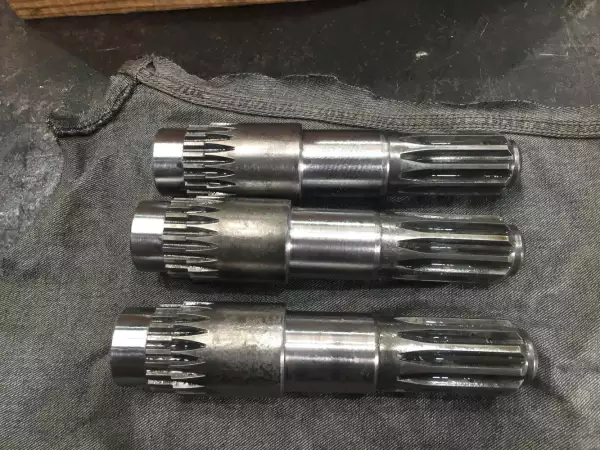
Image source: https://images.hzpt.com/uploads/2024/05/0_spline-shaft-17.webp
Our company specializes in the production and sale of various types of gears and spline shafts. With our extensive experience in the industry, we have established ourselves as a leader in providing high-quality products to meet our customers’ needs. Here are five key advantages of choosing our company:
- Advanced Manufacturing Techniques: We utilize state-of-the-art manufacturing techniques to ensure the precision and durability of our spline shafts.
- Quality Assurance: Our products undergo rigorous quality control measures to guarantee their performance and reliability.
- Customization Options: We offer a wide range of customization options to tailor our spline shafts to specific applications and requirements.
- Expertise in Spline Shaft Analysis: Our team of engineers has extensive expertise in analyzing the fatigue life of spline shafts under cyclic loading, ensuring the performance and longevity of our products.
- Responsive Customer Support: We pride ourselves on providing excellent customer support, assisting our clients throughout the entire process from selection to post-purchase service.
Spline Shaft Working Principle and Function
A spline shaft is a mechanical component used to transmit torque between two rotating objects. It features a series of ridges or teeth, known as splines, that mesh with corresponding grooves in a mating component. This design allows for efficient power transmission while accommodating relative axial movement between the connected components.
Spline Shaft Design and Selection Guide
When designing and selecting a spline shaft, several factors need to be considered. These include the required torque capacity, misalignment tolerance, axial movement requirements, and environmental conditions. It is crucial to ensure proper spline fitment and contact strength to ensure optimal performance and longevity.
Spline Shaft Manufacturing and Processing Techniques
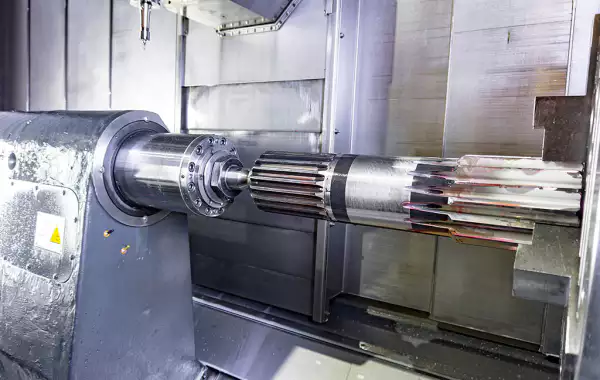
The manufacturing process of spline shafts involves precision machining to create the desired spline profile. Various techniques, such as hobbing, shaping, or broaching, may be employed depending on the specific requirements. Additional processing steps, such as heat treatment and surface finishing, are often implemented to enhance the shaft’s strength and wear resistance.
Spline Shaft Application Examples and Industry Practices
Spline shafts are widely used in various industries, including automotive, aerospace, and machinery. They are commonly found in applications such as power transmissions, gearboxes, and steering systems. Our spline shafts have been successfully applied in numerous projects, demonstrating their reliability and performance in real-world scenarios.
Partner with us today to experience the benefits of our high-quality spline shafts. We are committed to delivering superior products and excellent customer service to meet your exact requirements.
Author: Miya