Can spline shafts be repaired using cold spray technology?
Introduction
Spline shafts are crucial components in various mechanical systems, responsible for transmitting torque and rotational motion. Over time, these shafts may experience wear, corrosion, or damage, leading to a decrease in performance and potential failure. In this blog post, we explore the possibility of repairing spline shafts using cold spray technology and its potential benefits.

Understanding Cold Spray Technology
Cold spray technology, also known as supersonic particle deposition, is an emerging repair technique that utilizes high-velocity particles to restore damaged surfaces. Unlike traditional thermal spray methods, cold spray technology does not rely on heat for bonding, making it an ideal solution for delicate components like spline shafts.
1. Particle Acceleration
In cold spray technology, metal or composite particles are accelerated to supersonic speeds using compressed gas, typically nitrogen or helium. This acceleration is achieved through a converging-diverging de Laval nozzle, generating a high-velocity particle stream.
2. Particle Impact
When the accelerated particles impact the damaged surface of the spline shaft, they undergo plastic deformation due to high kinetic energy. This plastically deformed material forms strong metallurgical bonds with the substrate, effectively repairing the damaged area.
Potential Advantages of Cold Spray Technology for Spline Shaft Repair
1. Minimal Heat Affected Zone
Unlike traditional welding or thermal spraying methods, cold spray technology minimizes the heat affected zone (HAZ) during the repair process. This is particularly advantageous for spline shafts, as excessive heat can lead to distortion, loss of material properties, and dimensional inaccuracies.
2. Enhanced Material Compatibility
Cold spray technology allows for the use of a wide range of materials, including metals, alloys, and composites. This flexibility enables repair technicians to select materials with similar or improved properties compared to the original spline shaft, ensuring optimal performance and longevity.
Challenges and Limitations
1. Surface Preparation
Before applying cold spray technology, proper surface preparation is crucial to ensure effective bonding between the repaired area and the substrate. Any contaminants, oxides, or surface irregularities must be thoroughly removed through cleaning, grit blasting, or other suitable methods.
2. Complexity of Spline Shafts
Spline shafts often feature intricate geometries and precise tolerances. Repairing such complex components using cold spray technology may require specialized equipment, precise process control, and skilled technicians to achieve satisfactory results.
Conclusion
In summary, cold spray technology shows promise as a viable solution for repairing spline shafts. Its ability to restore damaged surfaces with minimal heat input, enhanced material compatibility, and the potential for extended service life make it an attractive option for industries relying on reliable and efficient mechanical systems. However, careful consideration of surface preparation and the complexity of spline shafts is necessary to ensure successful repairs. Embracing innovative repair techniques like cold spray technology can contribute to improving the longevity and performance of spline shafts in various applications.
Our company specializes in the production and sales of various types of gears and spline shafts. We take pride in our expertise and have several advantages over our competitors:
Advantages
- High-Quality Materials: We use only the finest materials for our gear and spline shaft production, ensuring durability and reliability.
- Precision Engineering: Our team of experts employs state-of-the-art technology and precision engineering techniques to manufacture spline shafts with exceptional accuracy.
- Customization Options: We offer a wide range of customization options, allowing our customers to tailor spline shafts to their specific requirements.
- Quick Turnaround Time: With our streamlined manufacturing process, we can deliver spline shafts promptly without compromising on quality.
- Competitive Pricing: Despite the superior quality of our products, we maintain competitive pricing to provide value for our customers.
Spline Shaft Working Principle and Function
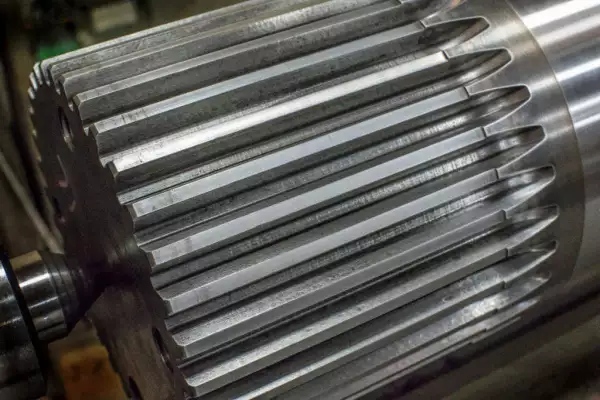
A spline shaft is a mechanical component used to transmit torque between two rotating shafts. It consists of a series of ridges or teeth that mesh with corresponding grooves in a mating part, creating a solid connection and enabling efficient power transfer.
Spline Shaft Design and Selection Guide
When it comes to designing and selecting spline shafts, several factors need to be considered, such as the required torque capacity, speed, operating conditions, and mounting requirements. It is crucial to consult our experts who can guide you through the design and selection process to ensure optimal performance and longevity.
Spline Shaft Manufacturing and Processing Technology
Our manufacturing process incorporates advanced technologies, including cold spray technology, which allows for the repair of spline shafts. This innovative technique involves spraying metal particles onto damaged areas, restoring their original dimensions and properties without the need for traditional welding or machining methods.
Spline Shaft Application Examples and Industry Practices
Spline shafts find extensive applications in various industries, including automotive, aerospace, machinery, and more. They are commonly used in power transmission systems, steering mechanisms, and other mechanical assemblies that require efficient torque transfer.
Author: Miya